The Gender War
How we ended up fighting the ghosts of dead systems

Evolution did not select for fairness. It selected for continuation.
Jealousy, selectivity, the pull toward status. None of it was designed. All of it was selected. The ones who felt no alarm at a mate’s wandering attention lost their line. The ones who chose without criteria lost more of what they carried. The ones who didn’t compete for position got passed over.
The instinct came first. The justification was always retrofitted.
The modern person is not confused because they lack values. They are confused because six timelines are running inside them at the same time. Each layer left instructions. Most of them contradict each other. Nobody told you which voice is which.
This is not the whole map. It is the layer people keep pretending is not there.
The cost of a reproductive event is not the same for both bodies. One body commits nine months of vulnerability per offspring. The other’s body is free from that cost but exposed to a different one: If no one selects him, his genes go nowhere.
The wiring is not a metaphor. It is chemistry, stress response, reward circuitry, attention, and threat detection. One system becomes more sensitive to bond rupture, reliability, and relational danger. The other becomes more sensitive to status, access, external threat, and position. These are not personalities. They are ancient threat maps running under modern language.

Neither is a moral position. Both are what survived. These are not personalities. They are pressures. Every person carries more variation than the model can hold. But the pressures are old enough to leave a tilt.
Wiring is not fate. It is pressure.
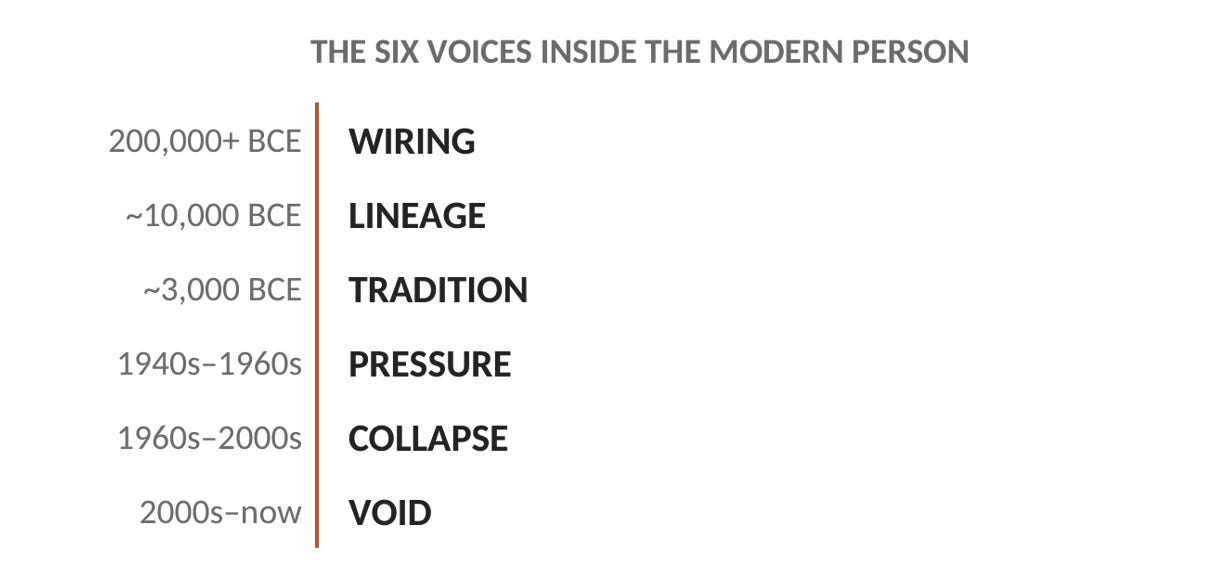
Each timeline began as a solution to pressure. Survival needed contribution. Property needed certainty. Empire needed obedience. War needed repair. Freedom broke the locks. The internet gave everyone a name for the wound and no way out of it. None disappeared. They stacked.
01 / WIRING
200,000+ years ago
Direct physical contribution. Hunt, gather, build, protect. Both sexes. The band was small enough that every member was visible. There was no surplus to hide behind. If you didn’t add value, fifteen to fifty people watched you fail in real time.
Mate selection happened through direct evidence: what you could see with your own eyes. Strength, reliability, generosity, skill. Neither sex was locked to a single person. Both could leave. The structure had no cage because it had no surplus to build one from.

Pair bonds formed but were not lifelong contracts enforced by law. Children were raised by clusters, not isolated units.
None of it was overwritten. It was only layered over.
02 / LINEAGE
~10,000 BCE to present
Twelve thousand years ago, the climate stabilized long enough for plants to be cultivated and animals to be domesticated. The bands stopped following food and started growing it. That single shift created surplus, and surplus created property, and property changed everything.

Men ended up owning the land, defending it, passing it down. Surplus had created something that didn’t exist before: wealth that could outlive a single person. The system needed someone to hold it, guard it, and decide who it went to next. Male bodies got assigned this role because they were already wired for territory and hierarchy. But the assignment came with a price. A man who couldn’t hold land was nothing. A man who died defending it was replaced. The cage turned men into instruments of the property system: valuable while functional, disposable when broken.
Women ended up producing heirs, managing the household, staying inside the system. Inheritance only works if paternity is certain. If you don’t know whose child it is, you don’t know where the land goes. The cage turned women into instruments of the inheritance system: valued through fertility, invisible outside it. The entire economic model required certainty: his labor had to stay committed, her reproduction had to stay trackable. Both bodies got locked down. Different locks.
This is where male emotional shutdown begins. A man defending land, fighting border disputes, burying his brother and picking up the weapon the same day, cannot afford to grieve. Survival calcified into identity.
This is where female hypervigilance intensifies. Her survival now depended on one bond instead of a community. If that bond failed, she had nothing.
Selection got taken out of individual hands. Families arranged marriages based on land, alliances, economic survival. What the wiring wanted stopped mattering. What the property system needed took over.
Once wealth was being passed to the next generation, the question of who made the offspring became the most important question in the economy. Female labor moved indoors and became invisible. Male labor moved into the fields and became the expendable kind.
The structure was not the wiring. It was the script built on top of it: origin became system, system became morality, morality became nature.
WHAT SURVIVED
Jealousy (repurposed as property protection)
Selectivity (repurposed as family strategy)
Status drive (funneled into land ownership)
WHAT DIED
Female economic independence
Male emotional range
Communal child-rearing
Flexible pair bonds
Any memory that the arrangement was constructed rather than natural
03 / TRADITION
~3,000 BCE to 1800s

Custom hardened into law, law merged with religion, and across centuries of empire the arrangement became old enough to feel like nature. Nobody alive remembered anything different.
Empires cannot run on individual desire. An empire needs soldiers who march without asking why and households that produce those soldiers without questioning the arrangement. The system needed predictable bodies, so it made disobedience sinful. For men: provide, fight, don’t feel. For women: obey, produce children, don’t want. The rigid script ran for roughly five thousand years in its strictest form, from the earliest legal codes through the pre-industrial era.
This is where male violence gets institutionalized. The system needed men who could kill on command without emotional collapse. Empathy was punished because hesitation on a battlefield gets your unit killed. Boys were trained to suppress every instinct except aggression and obedience. This is where female silence gets institutionalized. The system needed women who would comply without questioning the arrangement. Opinion was punished because a woman who challenged a marriage, a family decision, or a property transfer destabilized the entire structure. Girls were trained to suppress every instinct except agreeableness and service.
Marriage became a transaction between families: dowries, bride prices, virginity requirements, land, title, military rank. His worth was measured by what he could bring to the property line; hers by what she could produce. Both were inventory. Different shelves.
In much of the agrarian world, a woman’s recognized economic existence was tied to the household of a man. Her wiring still ran. She still read threat, weighed reliability, tracked who was safe. But the script told her who owned her. A man in 1500 had no exit from his role either. His wiring still ran. He still wanted purpose, connection, rest. But the script told him where to die.
Both caged. Both told it was nature.
The wiring is two hundred thousand years old. The property system is twelve thousand. The legal binding is five thousand. Most of the modern argument is people who cannot tell the difference.
04 / PRESSURE
1940s to 1960s

The rigid script had run on an agrarian economy: land, households, local authority. Industrialization started pulling people off farms and into cities in the 1800s. Factories replaced fields. Urban wages replaced land inheritance. The economic base the script had been built on was already shifting. Then the wars accelerated everything.
When millions of men were sent to the front lines of WWI and WWII, tens of millions of them did not come back. The economies behind them still needed to run. Factories needed workers. Farms needed hands. Supply chains needed operators. The workforce that had been doing this work was dead, injured, deployed, or psychologically shattered. The remaining labor had to come heavily from women.
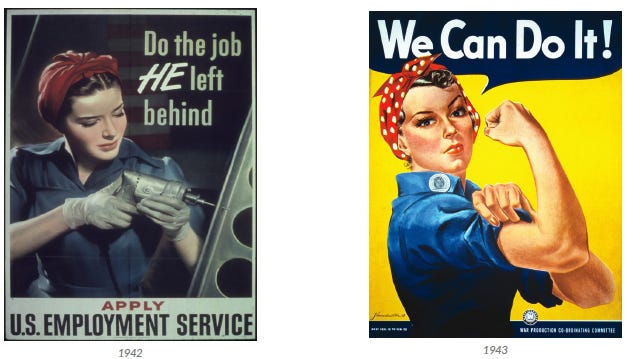
Wartime messaging recruited and motivated women in the workforce. The examples are American because postwar America had the loudest megaphone, but the pattern repeated across the industrialized world.
Then the men came home. Millions of them. Many had watched friends die, killed people they had no quarrel with, and spent years in conditions that shattered them. They came back to a culture that had no concept of trauma, no word for what they were carrying, and no tolerance for a man who couldn’t resume normal function immediately. They were expected to be grateful they survived, get a job, buy a house, and never mention it again. Millions of them carried that damage silently for the rest of their lives.
Meanwhile, the women who had been running the economy were told to go home. The population had been gutted. The institutions needed both reproduction and reintegration. Too many dead, not enough workers being born, and a generation of traumatized men who needed to be reabsorbed before the social order collapsed.
THE MACHINE
What followed was not organic. Every major institution pivoted at once to push both sexes back into fixed roles:
Advertising sold the house.
Psychology sold the guilt.
Religion sold the order.
Media sold the image.
Education trained the performance.
Policy funded economic reentry but ignored psychological damage.
Both sexes were managed. Men were told to provide and never speak about what the war had done to them. Women were fired and told they were no longer needed. The system didn’t care about either side’s wellbeing. It cared about restoring an economic order that required fixed roles.
Selection got romanticized as cover for the same economic arrangement. “Marry for love” replaced “marry for land.” But the pool was still pre-approved. The power dynamic was still fixed. The language changed. The structure didn’t.
WHAT SURVIVED
The belief that a man’s worth is tied to what he can provide
The belief that a woman’s worth is tied to being chosen
These beliefs got embedded deep enough that they outlived the legal enforcement by decades.
WHAT DIED
Overt ownership language
The explicit admission that it was economic
It got repackaged as romance, which made it harder to see and harder to name
05 / COLLAPSE
1960s to 2000s

The pressure held for about twenty years. But the structural cracks were already there. The postwar institutions papered over it, but they couldn’t undo what had been demonstrated. Once an economy absorbs a workforce, removing it means shrinking the economy. Once people have operated outside a role, telling them the role is nature rings hollow. The question was never whether the script would break. It was when.
The wars had proved women were capable of more than the script allowed, and men were carrying more than the script admitted.
Three structural shifts happened in sequence, and each one removed a load-bearing wall of the old system.
1. Fertility control. 1960. The pill gave both sexes something no generation before them had: sex without the automatic consequence of pregnancy. Every previous system, every property arrangement, every marriage contract had operated under one constraint: sex could mean a child. That constraint had been the foundation of the entire cage. Paternity certainty mattered because pregnancy was uncontrollable. Female sexuality got restricted because reproduction couldn’t be separated from sex. Once it could be, the structural reason for the restriction disappeared. Not the cultural belief. Not the instinct. The structural reason.
2. The economy shifted from muscle to thought. Industrial economies paid for physical labor, which gave male bodies a structural earning advantage. Post-industrial economies paid for cognitive and service work, where that advantage mattered less. Once some households had two incomes, the market repriced housing, education, childcare, and consumer life around dual earners. Women working became default not only through ideology but because the economy absorbed it and locked it in.
3. Legal exits opened. No-fault divorce, starting 1969. Previously, leaving a marriage required proving abuse, infidelity, or abandonment in court. Now either party could leave without proving cause. The contract that had been permanent became dissoluble. Between 1960 and 1980, the divorce rate roughly doubled. Not because people stopped valuing marriage. Because people in bad marriages finally had a mechanism to leave them. Both sexes used it.
When a cage that has held a species for five thousand years falls apart in three generations, the species inside it does not know what to do.
Each shift removed one structural lock. Fertility control removed the biological lock. The thought economy removed the economic lock. No-fault divorce removed the legal lock. When all three locks are gone, there is no mechanism left to enforce institutional mate selection. Selection defaults back to the individual, because nothing is forcing it to be collective anymore.
But the individual had no working model for this. The wiring, the property logic, the religious script, the romantic ideal, and the liberation framework all gave different instructions. They did not agree on what to want, who to choose, or what a good life looks like.
WHAT SURVIVED FROM THE PRESSURE ERA
The belief that a man who expresses what he feels is weak
The belief that a woman who chooses for herself is selfish
These beliefs got planted deep enough that many people carry them without knowing where they came from
WHAT DIED
Legal enforcement of permanent marriage
Economic dependency as absolute
Any single coherent script that tells you what is expected of you
06 / VOID
2000s to now

The three locks broke in sequence. Nothing replaced them. For the first time in twelve thousand years, neither sex had a working script. And into that silence came the loudest thing available.
Both sides carry damage. Neither can see the other’s clearly.
Each side’s cost looks like the other side’s privilege.
He can’t carry the household alone anymore. The economy moved on. But the wiring still says he should be able to. So he measures himself against a standard no one set and falls short of a role that no longer exists.
She can’t afford to depend on anyone anymore. The economy moved on. But the wiring still pulls toward the bond. So she builds her independence while something underneath keeps asking who has her back.
Both are running a program the environment no longer supports. Neither knows which voice to trust.
The confusion had no language. The internet gave it one.
The manosphere gave men a script. It said: women are commodities to be ranked, your worth is your bank account and your frame, emotions are weakness, and any woman who does not recognize your value is beneath you. It held because it gave displaced men a scoreboard. The script did not teach them to connect. It taught them to perform. And performance felt like power.
The femosphere gave women a script. It said: a man is not safety by default. He is a liability until proven otherwise. Vet him. Test him. Do not confuse attention with care, desire with commitment, or vulnerability with love. Do not build around a man who has not shown he can add to your life. It held because it gave restricted women a risk model. The script did not teach them to trust. It taught them to calculate. And calculation felt like safety.
Both scripts took real damage and turned it into identity. Once the pain becomes who you are, understanding the other side feels like betrayal. The algorithm saw this and fed it. Not because it wanted a gender war. Because a gender war gets clicks.
So the void filled with garbage.
Every attempt to define masculinity or femininity got sorted into political camps. Parents defaulted to silence because silence felt safer than saying the wrong thing. They did not realize silence itself created the vacuum. When a generation grows up without anyone explaining what they are feeling, they go looking online.

Neither of them is getting help. Both are getting content. The algorithm serves whatever gets engagement. Outrage gets engagement. So both sexes get fed the most extreme, most divisive version of gender available. The content is not trying to help anyone understand anything. It is trying to monetize the confusion.
Every person in this argument is running inherited instructions that contradict each other. Nobody is wrong about what they feel. Almost everyone is wrong about where the feeling comes from.
WHAT RUNS UNDERNEATH
Underneath all of it, the wiring keeps running. It runs in everyone, and it does not care about the names.
A man comes home and fixes the broken thing without being asked. Somewhere underneath, his wiring tells him this is what care looks like. His partner says he is emotionally unavailable. He hears this, and something inside him cannot understand it, because he just spent two hours in the cold fixing the thing, and that was not nothing.
A woman comes home and asks her partner about his day in detail. She remembers his coworkers’ names. She listens when he says nothing. Somewhere underneath, her wiring tells her this is what care looks like. Her partner says she is overwhelming. She hears this, and something inside her cannot understand it, because she was paying attention, and paying attention was not nothing.
These two systems were never meant to compete. One scans inward for bond quality. The other scans outward for external threat. One maintains the network. The other defends it. The species survived because both ran at once.
The war started when care delivered in one system stopped being read as care in the other. He gave everything he had, in his language. She gave everything she had, in hers. Both felt like they were doing too much. Both felt like they were receiving nothing. Not because either one stopped caring. Because the translation broke.
You cannot extract from someone what their wiring does not produce. But you can learn to read the care that is already there.
Not every man or woman maps cleanly onto this. But enough relationships break on this translation problem that the pattern matters.

But there is a deeper problem than the translation. Every generation before this one had a structure that kept both people in the arrangement. That structure is gone.
Now the only thing holding it together is choice.
The fear of being the one left carrying a life built for two is enough to stop most people from choosing at all.
So both sides hold back. Both perform a version of themselves that is safer but emptier. And both resent the other for not giving them the thing they stopped asking for, because asking became too dangerous.
The war is not two sides fighting over who is right. It is two sides punishing each other for a cost neither of them set.
Care does not have a single shape. It never did.
For one person it is being decided for. For another it is being asked. For another it is being left alone. For another it is being held. The form matters less than whether the person receiving it felt received.
A man who wants to lead and provide is not running the wrong script. A man who wants the weight shared is not running the wrong script.
A woman who wants a home and children is not running the wrong script. A woman who wants to build a company and never marry is not running the wrong script.
None of these are performed. They are felt. The performance is pretending they have to look a certain way.
Nobody alive wrote the script. Everyone inherited the damage.
The war does not end by one side winning. It ends when both sides realize they were never fighting each other. They were fighting the ghost of every system that told them who to be.
Sources are included as scaffolding for the historical and scientific claims. The synthesis is mine.
SOURCES / FURTHER READING
Image credits We Can Do It! (J. Howard Miller, 1943). Public domain. Do the Job He Left Behind (NARA, ca. 1942). Public domain.
Evolution and reproductive strategy Trivers, R. (1972). Parental Investment and Sexual Selection. Buss, D. (2019). Evolutionary Psychology: The New Science of the Mind (6th ed.). Routledge. Geary, D.C. (2010). Male, Female: The Evolution of Human Sex Differences (2nd ed.). APA.
Agriculture, property, and patriarchy Lerner, G. (1986). The Creation of Patriarchy. Oxford University Press. Scott, J.C. (2017). Against the Grain: A Deep History of the Earliest States. Yale University Press.
Ancient legal-religious gender hierarchy Pomeroy, S.B. (1975). Goddesses, Whores, Wives, and Slaves. Schocken. Goldstein, J.S. (2001). War and Gender. Cambridge University Press.
Postwar domesticity and the family ideal Friedan, B. (1963). The Feminine Mystique. W.W. Norton. May, E.T. (2008). Homeward Bound: American Families in the Cold War Era. Basic Books. Coontz, S. (2005). Marriage, a History. Penguin.
The Pill, divorce, and family change Goldin, C. & Katz, L. (2002). The Power of the Pill. Journal of Political Economy, 110(4). Stevenson, B. & Wolfers, J. (2007). Marriage and Divorce: Changes and their Driving Forces. Journal of Economic Perspectives, 21(2). Autor, D. et al. (2019). When Work Disappears. American Economic Review: Insights, 1(2).
Algorithms and gender discourse Nagle, A. (2017). Kill All Normies. Zero Books. Ging, D. (2019). Alphas, Betas, and Incels. Men and Masculinities, 22(4). Zuboff, S. (2019). The Age of Surveillance Capitalism. PublicAffairs. Haidt, J. (2024). The Anxious Generation. Penguin Press.
Further reading Harari, Y.N. (2015). Sapiens: A Brief History of Humankind. Harper.